Grow in Haus
Designing a New Manager Development Programme
There is one sentence we keep repeating in leadership training: Being a good specialist does not guarantee being a good leader.
Being good at your job is of course an important resource in the move to management. But this new responsibility requires other skills alongside a person’s expertise: clarifying expectations, sharing responsibility, supporting development and creating conditions where people with different needs and working styles can work together.
This need applies as much to people who have held the responsibility for some time without ever having the chance to prepare for it as it does to first-time managers. With the move into management, both a person’s relationship with their work and what we expect of them change.
As our expectations rise, how much room are we making as an organisation for people to prepare for these new responsibilities, and are we really designing the right programme?
Using the LEADS model from the Association for Talent Development (ATD) as a guide, we have put together five core steps for a new manager development programme:
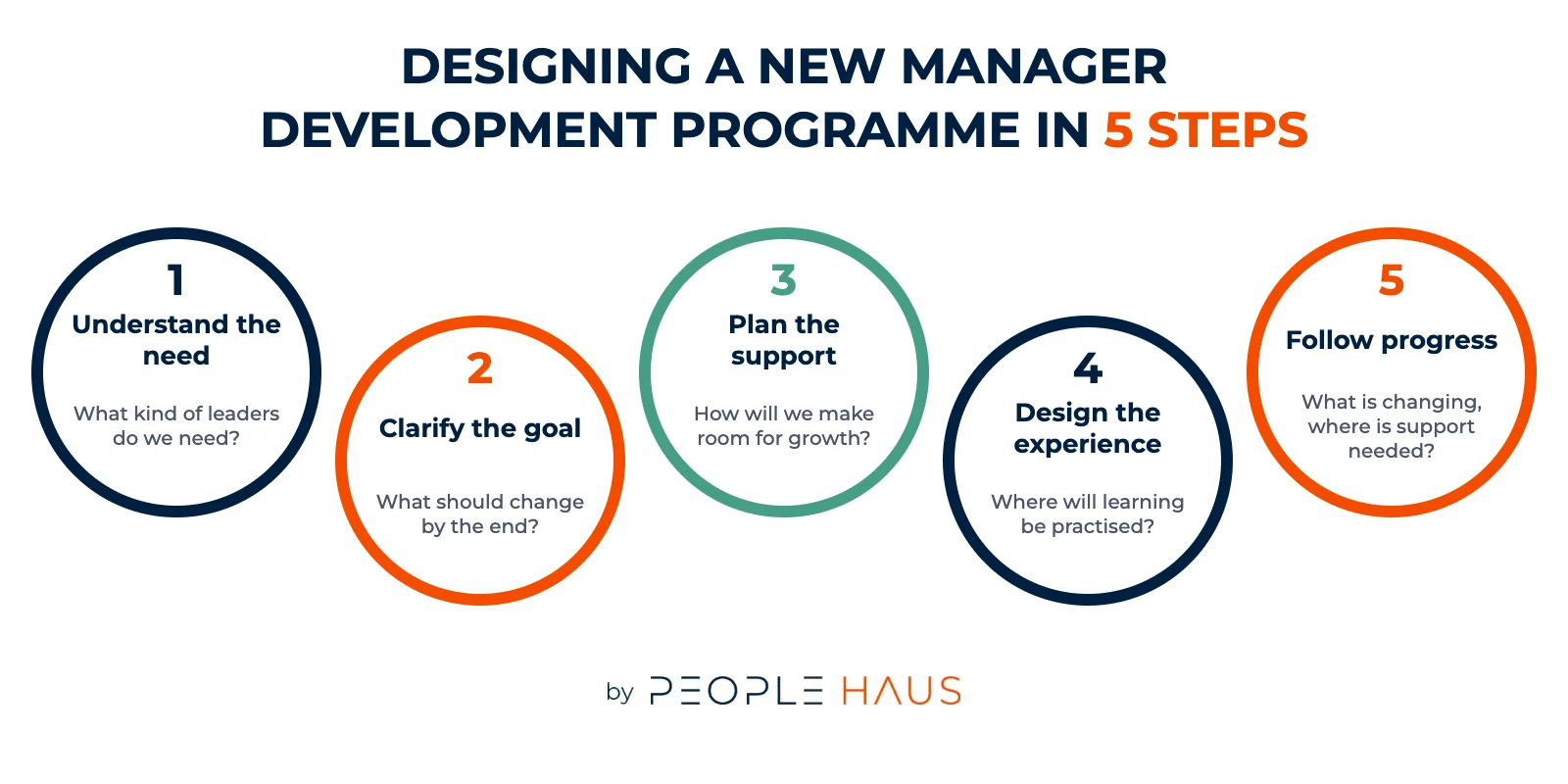
1. Lay a solid foundation: what do we need?
When designing a programme, choosing topics and participants is exciting, and it is often where we start. But as with training design, a development programme first needs us to understand the real need, so that we can work made-to-measure and create a structure unique to our organisation.
Every organisation has different priorities, working cultures and employee profiles. So it is hard to be clear about what kind of leaders we need without putting the organisation’s values, the challenges of daily work, senior management’s goals and mutual expectations on the table.
At this point we listen to the managers themselves, their teams and their senior managers. This lets us see both the skills that need developing and the conditions that make those skills harder to use.
2. Clarify the goal: what do we want to change?
Once we understand the need and have laid the foundation, we can talk about what we expect to change by the end of the programme. “Let leadership skills improve” gives us a direction, but it does not say exactly what we want to see differently in daily work.
So we define the competencies we need through behaviours we can observe. We set priorities by considering the organisation’s expectations and participants’ development needs together. Everyone then knows what to focus on, and we have made clear from the start how we will assess development later on.
3. Agree on the action plan: how will we support this process?
With clear goals, we can start building the plan that will bring them to life. Who will take part, what schedule will we follow, what resources will we use and who will take on which responsibility?
Of course, we also need to discuss this plan with participants’ managers, so that what we expect in the programme is supported in daily work too. That is why it is important to clarify the time set aside for learning, practice opportunities and feedback support from the outset. This is also where we can look at how to connect with existing development work, which means thinking about the programme’s continuity within the organisation.
4. Design development experiences: where will the learning be tried out?
We have the plan, but where will participants try out what they learn? Creating the space that makes behaviour concrete is one of the most valuable parts. For this, we build a flow that draws on real work experiences and moves forward through practice and feedback.
Every module should at least be able to answer this: “What will the participant try out at work before the next session? And how will we provide the space for that?”
As you know, learning does not fully happen until theory meets practice.
Depending on the need, we can also bring mentoring, coaching and peer meetings into the process. Participants then get the chance to reflect on their experiences and try again. A meta-analysis of leadership training also supports the use of needs analysis, practice, feedback and sessions spread over time.
5. Keep the process alive: measure the change
While this is going on, we also need to return regularly to the goals set at the start. In other words, we do not fall into a “done and dusted” mindset. Rather than waiting for the programme to end before evaluating, we follow the change at regular intervals along the way.
Which behaviours are participants trying out, how are their teams experiencing the change, and where is support needed?
It is very important to link measurement from the very start to the behaviours we set in step two. To do this, we can draw on the Kirkpatrick model.
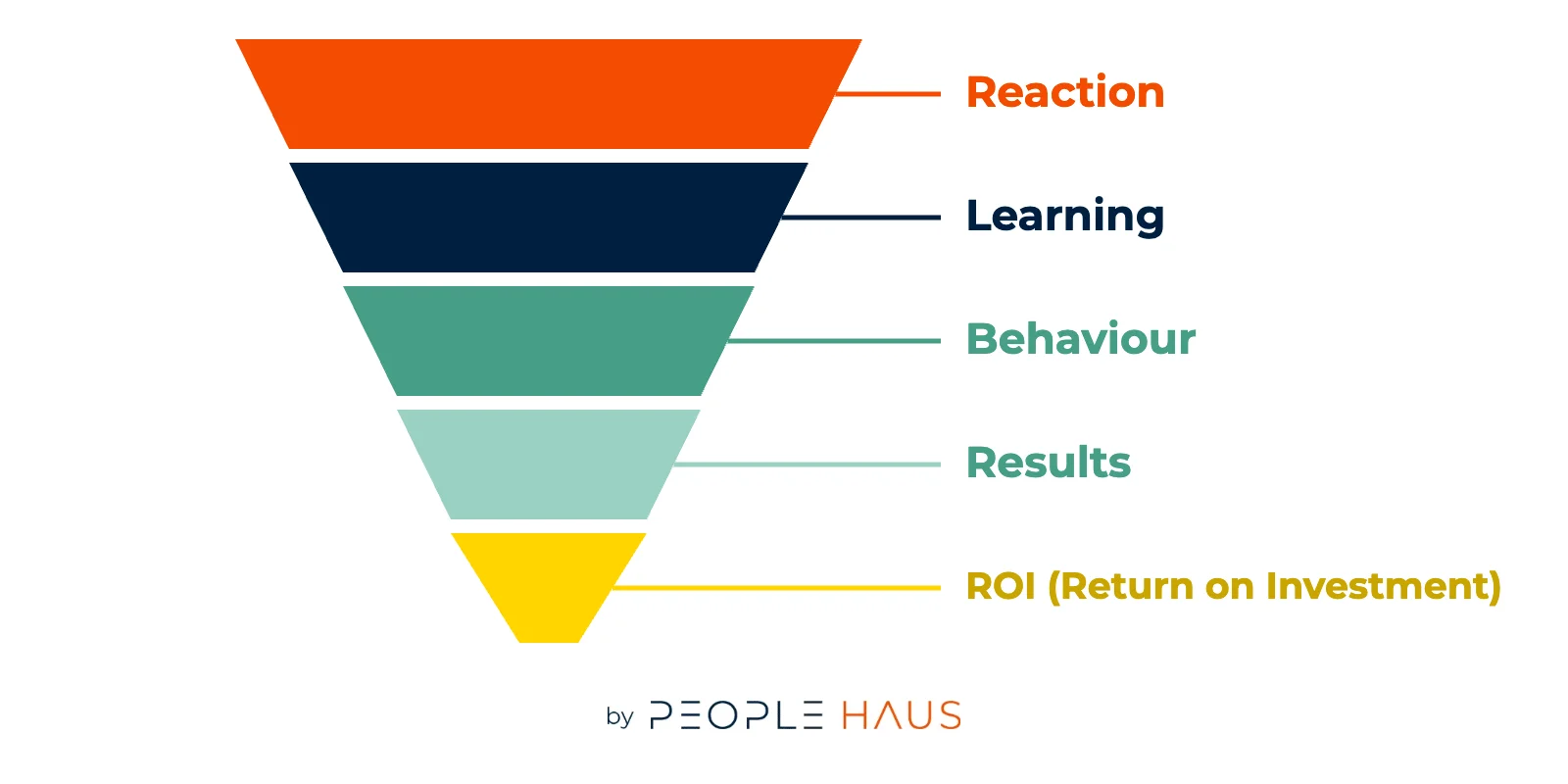
Bringing together the views of participants, their teams and their managers, and using 360-degree feedback where needed, lets us look at development from different perspectives. We update the programme with what we learn here, so that evaluation also becomes a part that feeds development.
In the NEXT Young Talent Programme we run with Ajinomoto Türkiye, we also built a structure that connects development with real work experiences. Through training, learning circles and impact projects, we support internal talent to get to know the organisation better, analyse business problems and develop solutions. Although it serves a different audience, this experience also guides new manager development programmes, through our approach of linking learning to the organisation’s needs and turning it into practice at work.
Warmly,