Grow in Haus
An Inclusive Roadmap for Organisations
Inclusion has become one of the more visible concepts on organisational agendas in recent years. But visibility does not always mean transformation of the same depth. For some organisations, inclusion is still limited to campaigns on particular days, policy documents, diversity headlines or surface-level awareness training.
What today’s business world needs is not to position inclusion as rhetoric, but to place it in decision-making, leadership behaviour, employee experience and the daily flow of organisational culture. That is why an inclusive roadmap offers an important framework for turning inclusion from a well-meaning approach into sustainable culture change.
The World Economic Forum’s 2025 Diversity, Equity and Inclusion Lighthouses report also stresses that organisations getting effective results treat this area not as one-off projects, but as measurable, owned areas of transformation integrated into core business processes.
One of the most common misconceptions about inclusion is that it means creating the same experience for everyone. In fact, inclusion does not mean that everyone in an organisation has the same experience. It means that different needs, backgrounds, voices and ways of working are met on a fair footing.
The Business World Diversity and Inclusion Guide from UN Global Compact Türkiye describes diversity and inclusion as involving all individuals and communities in processes and systems, regardless of differences such as gender, sexual orientation, ethnic identity, age, religious and political views or disability. The guide also defines groups who face discrimination for any reason as those “left out”, and stresses that workplaces must offer working environments worthy of human dignity.
So building an inclusive organisational culture begins with this question:
How safe, valued, visible and influential do the people here feel?
Why is inclusion a strategic issue today?
Hybrid working, differing generational expectations, AI and digitalisation, competition for talent, fluctuating engagement and the search for meaning are all transforming how organisations work. This many external pressures and expectations force organisations to rethink themselves culturally, not just operationally.
McKinsey’s Diversity Matters Even More research also looks at diversity and inclusion in terms of financial and organisational outcomes, not only representation. Examining 1,265 companies across different geographies, it draws attention to the relationship between diversity and corporate performance.
But here is the critical point: diversity alone is not enough.
Having different people in an organisation does not mean their voices are heard, that they take part in decisions or that they have fair access to development opportunities. An inclusive roadmap makes it possible to address diversity beyond representation, through employee experience, leadership behaviour, fair systems and measurable culture change.
Organisations often begin their diversity and inclusion work with training, awareness seminars or communication campaigns. These can be valuable starting points, but they are not enough on their own. Inclusion grows stronger not only when employees know about the topic, but when the organisation’s systems are redesigned to support that knowledge.
So what can organisations do on this path?
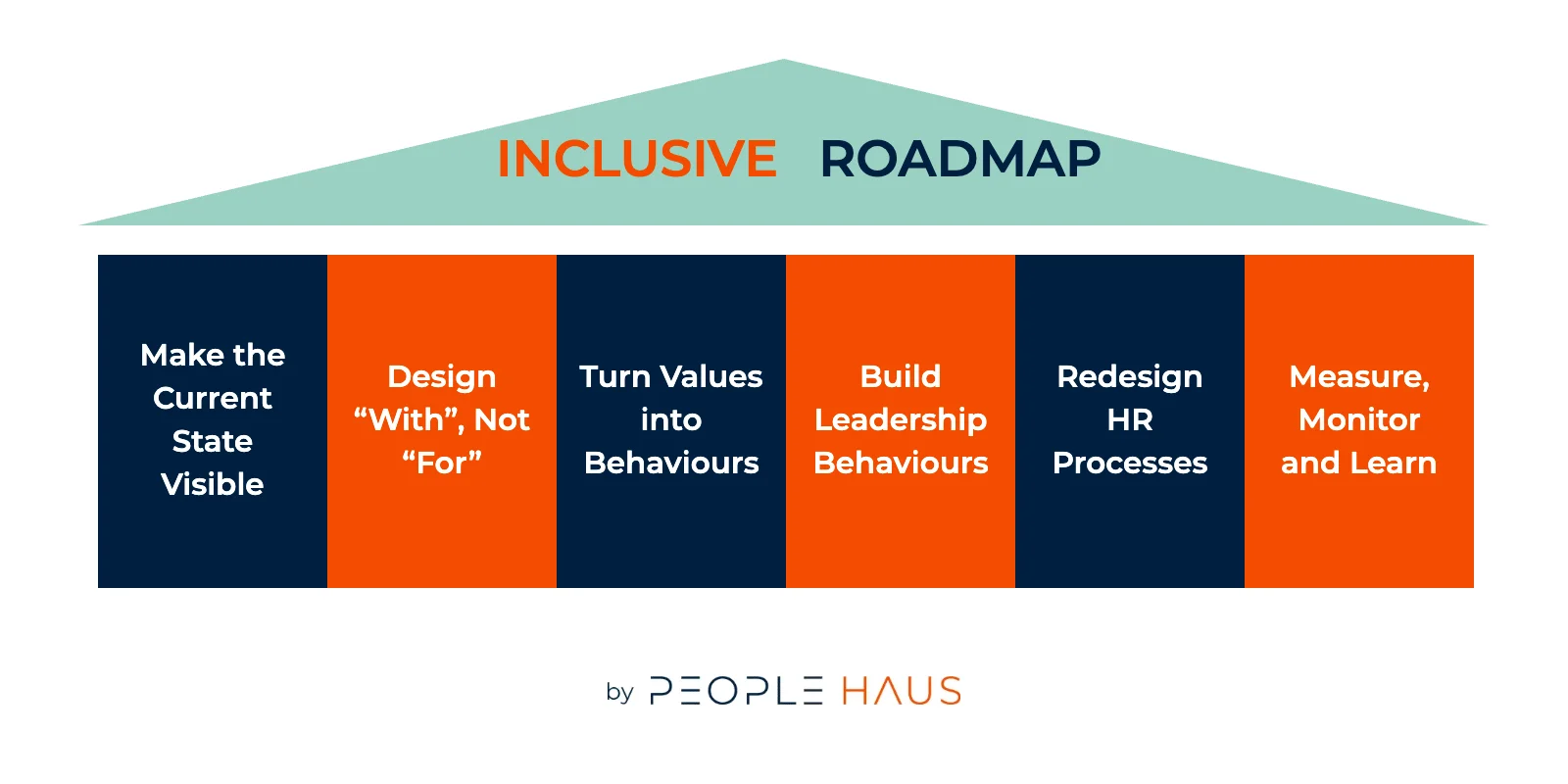
Step one: make the current state visible
The first step of an inclusive roadmap is to understand where the organisation is today. Every organisation’s culture is unique, and inclusion needs do not begin in the same place.
So the process should begin by trying to understand what employees actually experience.
- Do employees feel included in decision-making?
- Are there invisible inequalities between the experiences of different employee groups?
- Is the language used in the organisation safe and inclusive for everyone?
- Do hiring, onboarding, performance and promotion processes follow fair criteria?
- Are there safe channels where employees can express their needs?
- Do leaders see differences as a risk to be managed or as potential to be developed?
The first step in preparing an inclusive roadmap is therefore to see the organisation’s current cultural picture honestly and from many angles.
Step two: design “with”, not “for”
One of the most critical traps in inclusion work is making decisions on behalf of excluded groups without involving them in the process.
An inclusive culture is designed by listening directly to experience, not by assuming needs. That is why the principle of “not for them, but with them” in the Global Compact Türkiye guide gives such strong direction.
Nobody can fully describe someone else’s experience on their behalf. The way to understand which barriers an employee faces, in which processes they feel invisible and where they need support is not to speak for them, but to open a safe space where they can speak.
That is why employee listening mechanisms, focus groups, anonymous feedback channels, representative groups and co-design workshops hold an important place in an inclusive roadmap. Inclusion gains meaning when it stops being a policy written at a desk and becomes a culture that develops in the field, through listening and thinking together.
Step three: turn inclusion from values into behaviours
Many organisations list concepts such as respect, equality, trust, openness or people-centredness among their values. But when these values do not become behaviours, they struggle to make a strong impact on culture.
This is where one of the frameworks we use often at People Haus comes in: the value, behaviour, impact chain.
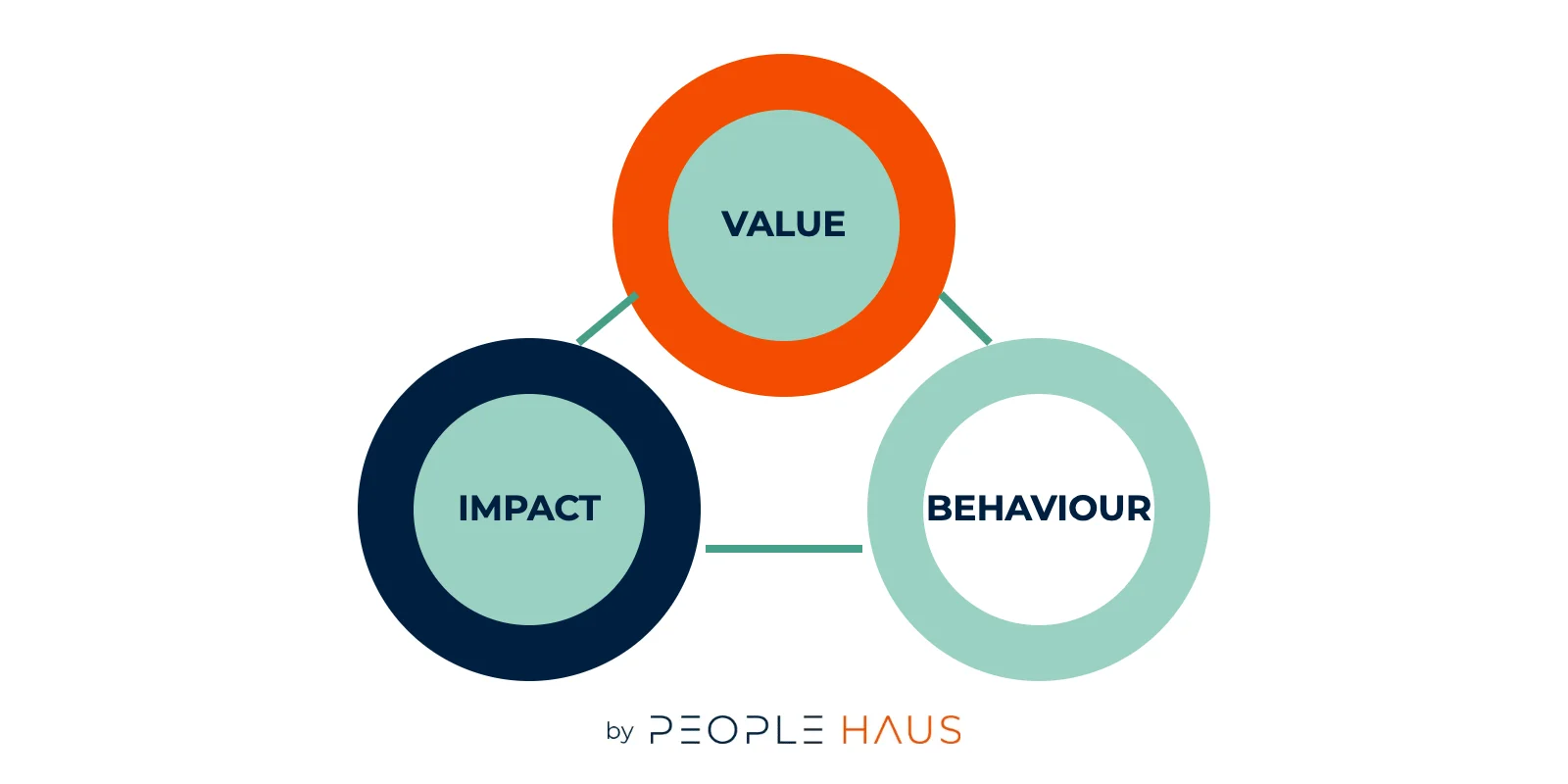
If inclusion is one of an organisation’s values, its daily behavioural equivalent should be defined. The effect of these behaviours on employee experience and business results should also become measurable.
For example, if “psychological safety” is stated as an organisational value, its behavioural equivalent is more than “everyone can speak”. More concretely, different views should be deliberately invited in meetings, conversations about mistakes should focus on learning rather than punishment, leaders should be open about what they do not know, and team members should not feel a relational risk when they disagree.
Research published in Harvard Business Review also stresses that psychological safety is a critical condition for diverse teams to perform at a high level. For differences to become real contributions, it is not enough for different people to be together. It takes a culture in which those differences can be expressed safely.
Step four: turn inclusion into leadership behaviour
Leaders are the real carriers of inclusion and other organisational values. Employees usually learn an organisation’s values not from documents, but by watching their managers’ daily behaviour.
Who a leader gives the floor to in a meeting, whose idea they make visible, how they react to mistakes, how they give feedback and how much room they make for different needs are among the most concrete signs of an inclusive culture.
So inclusive leadership training should not stop at explaining concepts. It should create experiential spaces where leaders assess their own team dynamics, notice their biases, think through case studies, review their decision-making and develop tools they can turn into daily behaviour.
Step five: redesign HR processes
In an organisational culture, inclusion lives not only in the language of communication but also in systems.
The language of job adverts, the structure of interview questions, candidate assessment criteria, the inclusiveness of onboarding, the clarity of performance reviews, the transparency of promotion decisions, access to development opportunities and pay policies are the real testing grounds of inclusion.
An organisation may advocate inclusion, but if it consistently leaves out certain profiles in hiring, relies on vague criteria in performance reviews or offers development only to visible employees, inclusion will not be reflected in the employee experience.
That is why it is important for organisations to ask themselves:
- Could our job adverts be leaving out some candidates without us noticing?
- Do our interviews offer every candidate an equal, structured experience?
- Do new employees have access to social and cultural inclusion as well as technical knowledge?
- Are our performance criteria clear enough?
- Are development and promotion opportunities distributed fairly?
- Do we take employees’ different life circumstances and needs into account when designing processes?
Inclusion is not a side topic for human resources. It is a fundamental perspective that calls for rethinking the whole employee life cycle.
Step six: measure, monitor and learn
One of the most frequent risks in inclusion work is measuring impact only by the number of activities delivered.
How many training sessions took place, how many people attended or how many campaigns were published all matter, but they are not enough on their own. The real issue is what has changed in the employee experience.
Do employees feel a stronger sense of belonging? Is the gap between the experiences of different employee groups closing? Is there a visible change in leaders’ behaviour? Are feedback and reporting mechanisms being used? Are more voices heard in meetings? Are promotion, development and pay processes producing fairer outcomes?
Measurement should be done not only for accountability, but to see where to intervene more accurately. Inclusion is a matter of culture that lives, changes and has to be learned again and again.
That is why an inclusive roadmap should be thought of as a living system. It should be measured, listened to, revised and applied again.
Inclusion starts with language
Building an inclusive culture is not limited to policy, strategy or training topics. The place employees first feel inclusion is often not big decisions but everyday language.
Language is one of the most visible touchpoints of a culture. The form of address in a meeting, the choice of words in a job advert, the examples used in internal announcements, the way leaders speak, how people joke, the wording of feedback and the images in training materials all shape how inclusion is lived day to day.
Inclusive language is more than choosing the “right words”. It is a way of communicating that does not label people or box them into assumptions, that makes different experiences visible and that gives everyone room to feel a natural part of the organisation.
For example, the phrase “young and dynamic team member” in a job advert can create an age-related expectation without anyone noticing. Everyday jokes, generalisations or stock phrases can leave some employees feeling invisible or excluded.
The point is not to make language artificial. It is to see who our language includes and who it leaves out without us realising.
Language is a rehearsal for behaviour. So inclusion begins in language, but it does not stay there. It creates real transformation when it spreads from language to behaviour, from behaviour to systems and from systems to culture.
Inclusion is not a project, it is an organisational muscle
An inclusive roadmap should not be seen as a short-term project with a start and end date. It is better understood as an organisational muscle that grows stronger over time.
This muscle develops through data, listening, leadership behaviour, fair systems, psychological safety, inclusive language and continuous learning.
Seen this way, an inclusive roadmap is more than a planning document. It is a transformation guide that lives alongside the organisation’s language, leadership approach, HR processes and daily behaviour.
The core issue is no longer just bringing different people under the same roof. It is designing a working experience in which everyone under that roof feels valued, visible, heard and able to contribute.
If you want to move inclusion beyond rhetoric and into a sustainable culture that lives in language, behaviour, leadership practice and employee experience, we can design your inclusive roadmap together. 🧡
Warmly,
Sources and further reading
- Bresman and Edmondson (2022), Research: To excel, diverse teams need psychological safety, Harvard Business Review
- Global Compact Türkiye, Business World Diversity and Inclusion Guide (in Turkish)
- McKinsey & Company (2023), Diversity matters even more: The case for holistic impact
- World Economic Forum (2025), Diversity, Equity and Inclusion Lighthouses 2025