Grow in Haus
Creating Impact in Corporate Training
The end of a corporate training day:
- When it ends, you ask participants how it was. “It was amazing!” they say.
- Two weeks later, you ask what they remember. “Hmmm… there were some headings.”
- A month later, you ask what has changed, and their eyes drift to the ceiling.
In 1885, the German psychologist Hermann Ebbinghaus set out to study a question many had overlooked: “How quickly do people forget what they learn?”
The result: our memory of new information starts to decline systematically as soon as we learn it. This is what we call the Forgetting Curve.
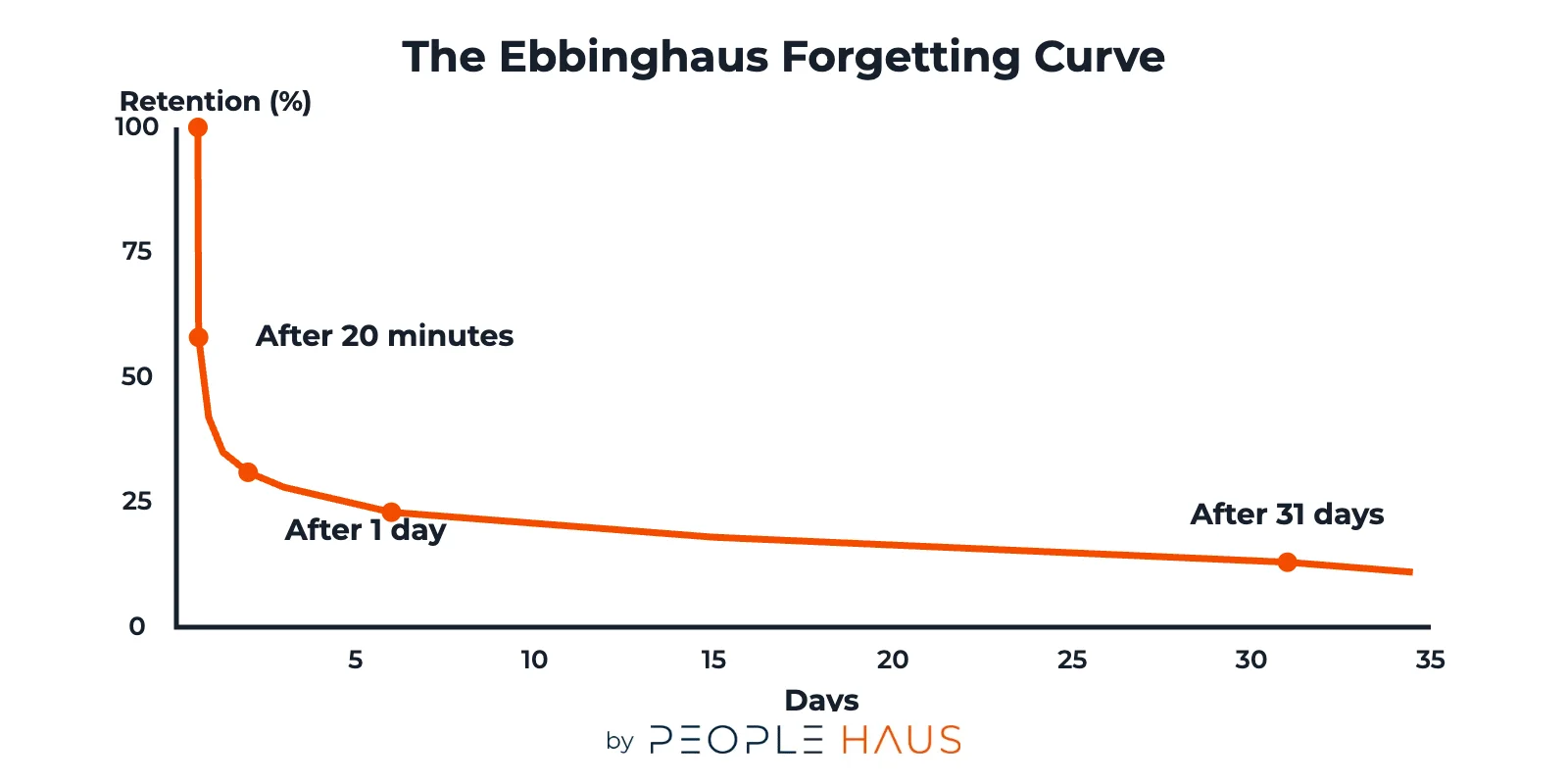
The real point of training is not to create magic in the moment but to leave a mark. The forgetting curve reminds us of this bluntly. What matters is not that a participant leaves saying “We had fun, it was great!” What matters is hearing “I used it when writing an email a month later” or “I approached a customer this way last week.”
In short, we measure the quality of corporate training not by what is in our minds as we leave the room, but by how long it stays there, how it shows up in the field, what it changes and who that change affects.
So how do we break the forgetting curve in corporate training?
Information only settles into long-term memory through repetition spaced over time (Cepeda et al., 2006). Of course, we first shape the work around where we want to arrive. To understand how well training is working, it is not enough to ask “Were participants satisfied?”
The most elegant framework for moving corporate training from “it was great” to “it worked” is still Kirkpatrick’s four levels:
Reaction → Learning → Behaviour → Results.
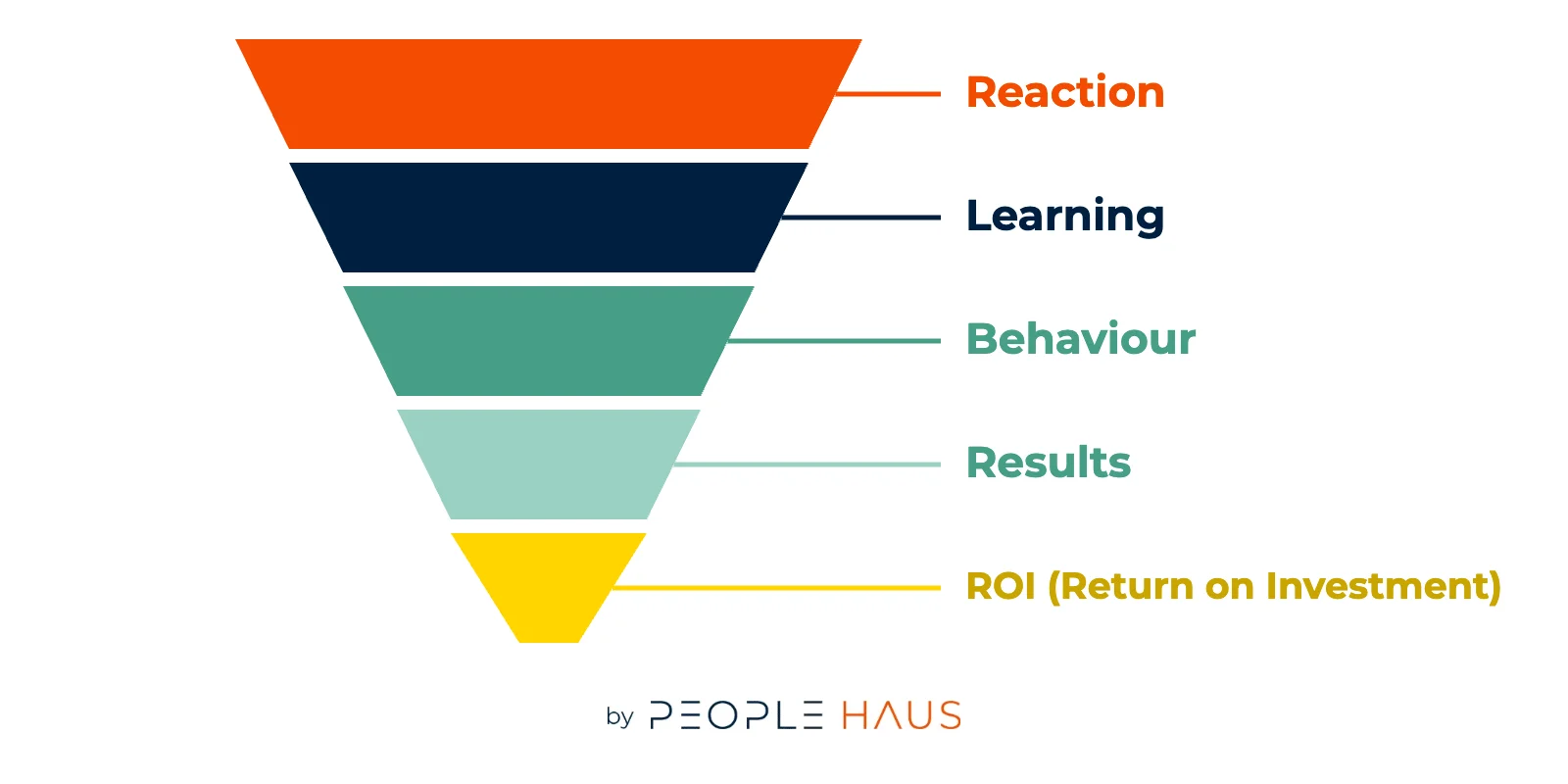
The Kirkpatrick Model is one of the most comprehensive ways to analyse the effect of training at four different levels, and it works almost like a guide for us as trainers. It lets us follow the whole process step by step, from the emotional effect of training to its transformation into behaviour. That way we can give clear answers not just to “Did we deliver training?” but to “What did we change?”
If someone did not like the training, learning can stall from the very start. So this level answers the question “Did we get through the door?”
Level 1: Reaction. “How did participants feel about this training?”
The first step is the participant’s impression of the training. At this stage we measure reactions to the programme: how much participants liked it and how they felt about it. It is important to assess every component, including the content, activities, methods, learning environment and the trainers’ performance.
- Would participants attend this training, or your other training, again?
- Was the content engaging?
- Was the trainer competent?
- Did the training meet expectations?
- Did participants show engagement and attention during the session?
- How successfully did the trainer involve participants and hold their attention?
- Did the training speak to the participant’s work and world?
- Do they think what they learned can be applied?
How to measure it:
- Likert-scale surveys
- Reaction forms
- Open comment fields: “What did you like most?”, “What was missing?”
- A “describe the training in one word” card game
These forms are more than feedback. They also help participants feel part of the training.
Level 2: Learning. “What did participants learn in this training?”
At the second stage we measure what participants learned and whether their knowledge grew. To do this, we need to decide which areas to assess. These may be changes in knowledge, skills or behaviours.
At this level we put the trio of knowledge, skills and attitudes at the centre, looking at how useful and credible the learning experience was and how likely it is to be applied in real life.
- Did the participant’s knowledge grow?
- Did they gain a new skill?
- Did their belief in and willingness to apply this skill develop?
- Did they gain confidence about adapting it to real life?
Assessment dimensions:
- Knowledge: How much do they remember?
- Skill: Participants’ ability to perform in a particular way.
- Attitude: How do they view learning? Participants’ belief in the value of both the learning experience and its use in real life.
- Confidence: How strong is the feeling of “I can do this”? Participants’ perception of their ability to apply what they learned. Taking time to build this confidence increases the likelihood of transfer to real life.
- Commitment: How willing are they to apply what they learned? Participants’ readiness to make the effort to use their learning outside the learning environment.
How to measure it:
- Pre-test and post-test
- Practice-based exercises
- Scenario-based application
- Role play
- Confidence scoring: “From 1 to 10, could you give someone effective feedback right now?”
- Participant self-assessment forms
Level 3: Behaviour. “How far has the participant integrated this training into their life?”
Gaining knowledge is not enough. What really matters is creating behaviour change. At this level we are asking “Is what was learned actually being applied?” and assessing how the training transfers to real life. Real behaviour change is earned through the follow-up steps we put in place after training. Most learning experiences aim to change participants’ real-life behaviour, which makes this a very important level of evaluation.
The transfer of learning into behaviour change is often limited by the post-training environment, which may not give participants opportunities to show their new knowledge or skills.
When designing a learning experience, it is therefore essential to consider the factors in participants’ own environment that can affect these behaviour changes.
- Has behaviour changed?
- Does the work environment support this change?
- Was the participant given the opportunity to apply this behaviour?
Among all the behaviours targeted in training, we aim to identify the most critical ones, then observe and reinforce them. Not every behaviour is equally important. There are key behaviours that show the effect of learning. If these change, the training can truly be considered effective.
For a participant to make a learned behaviour last, they need supportive factors around them. Behaviour change does not come from individual effort alone. The organisation’s systems, the manager’s support and coaching all help to sustain it.
- Supportive systems and reinforcement (for example follow-up systems, reminders, feedback that supports the behaviour)
- Rewards
- Encouragement (for example coaching, mentoring)
- Accountability systems
- Performance monitoring (for example KPIs, observation, reviewing work, action plans, surveys)
Note: If behaviour change is not observed, the problem may not lie in the training but in the environment where it is applied. So this level concerns the organisation as well as the participant.
Level 4: Results. “What difference did this training make to the organisation?”
This is the most abstract but most critical level. How did the training serve organisational goals? What measurable improvements followed it?
Possible outcomes:
- Higher customer satisfaction
- Increased sales
- Stronger employee engagement
- Better process efficiency
This level lets us measure the return on investment (ROI) of training. If we want concrete, strategic results for the organisation, we should not design training without thinking about this layer.
Learning that we do not measure leaves no trace in organisational culture.
The forgetting curve tells us how nature works, and Kirkpatrick shows us the way: move beyond reaction, prove the learning, bring it down to behaviour and connect it to results. First clarify “What is a meaningful result for us?”, then design backwards.
Warmly,